
How Religion Shapes Sex and Relationships in Dubai
You can’t talk about sex and relationships in Dubai without talking about religion. It’s not just background noise-it’s the foundation of how people live, love, and connect. Whether you’re a local, an expat, or just visiting, understanding this connection isn’t optional. It’s essential.
What You Need to Know Right Away
- Public displays of affection are restricted, not because of prudishness, but because of religious law.
- Marriage between Muslims and non-Muslims is legally complex and often requires conversion or special permission.
- Cohabitation outside of marriage is illegal and can lead to fines or deportation.
- Same-sex relationships are criminalized under UAE law, rooted in interpretations of Islamic teachings.
- Many expats adjust by keeping relationships private, not out of shame, but out of necessity.
The Real Impact: Religion Isn’t Just a Belief-It’s the Law
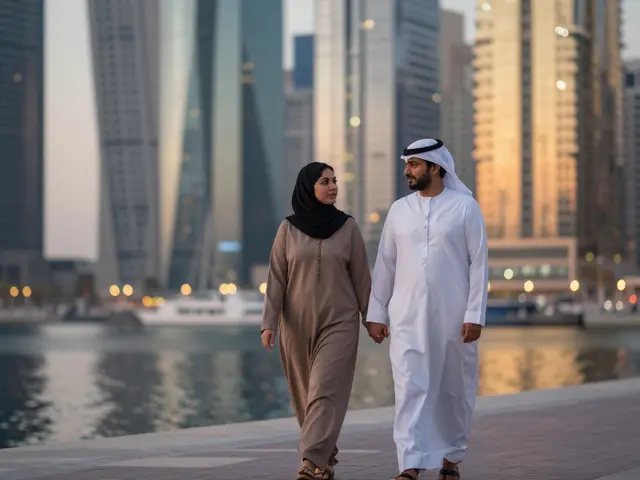
Dubai doesn’t separate religion from daily life. The UAE’s legal system is built on Islamic principles, especially in matters of family, marriage, and personal conduct. Sharia law isn’t something you read about in textbooks-it’s enforced in courts, police stations, and even hotel lobbies.Take public affection. Holding hands? Fine if you’re a married couple and no one’s watching. Kissing? That’s a potential arrest. Not because locals are judgmental, but because Article 358 of the UAE Penal Code makes any public display of intimacy punishable by law. This isn’t about policing morality-it’s about enforcing a legal framework tied to religious norms.
And it’s not just foreigners who feel the weight. Even Emiratis navigate this space carefully. A young couple might text all day, but meet only in family homes. Dating apps? Used, but with extreme caution. Profiles often hide last names. Photos are cropped to avoid showing skin. The culture of discretion isn’t about repression-it’s about survival.
Marriage: The Only Legal Framework for Intimacy
In Dubai, marriage isn’t just a celebration-it’s the only legal pathway to sexual intimacy. Outside of marriage, even consensual relationships carry serious risks. Expats who live together without being married can face deportation, fines, or jail time. Courts have ruled on cases where couples were caught sharing an apartment and charged with “immoral cohabitation.”For Muslims, marriage is governed by Sharia courts. Non-Muslims can marry under their own religious laws, but only if both parties are from countries recognized by the UAE. A Christian American marrying a Hindu Indian? Possible, but only if they register through their embassies and get approval from the Ministry of Justice.
Interfaith marriages are even trickier. If a Muslim woman marries a non-Muslim man, the marriage is automatically invalid under UAE law. If a Muslim man marries a non-Muslim woman, she must be from a recognized Abrahamic faith-Christian or Jewish. And even then, the husband must prove he won’t pressure her to convert. The system doesn’t ask if you love each other. It asks if you follow the rules.
Same-Sex Relationships: Invisible but Not Absent
Same-sex relationships are illegal in Dubai. Article 354 of the UAE Penal Code criminalizes sexual relations between people of the same gender. Penalties can include imprisonment and deportation. But here’s the reality: gay and lesbian couples still exist in Dubai. They just don’t talk about it.Expats in tech, finance, and diplomacy often form tight-knit underground networks. They meet in private homes, use encrypted apps, and avoid bars or clubs that attract local crowds. Some rent apartments under one person’s name to avoid suspicion. Others travel to Thailand or Portugal for vacations where they can be open.
There’s no official support system. No Pride parades. No public advocacy. But that doesn’t mean there’s no community. It just means survival depends on silence. The cost of visibility is too high.

How Expats Adapt: The Art of Discretion
Most expats don’t come to Dubai to fight the system. They come for jobs, opportunity, and stability. So they adapt.Many choose to marry quickly after arriving-not because they’re ready, but because it’s the only way to avoid legal trouble. Some couples delay intimacy until after the wedding ceremony, even if they’ve been together for years. Others live with flatmates of the same gender to avoid raising red flags.
Even simple things change. A couple might kiss goodbye at the airport, but never at home. They’ll post pictures on Instagram-but only of coffee dates, not hugs. They’ll say “friend” instead of “partner.” They learn the unspoken rules fast.
It’s not hypocrisy. It’s strategy. You don’t have to agree with the rules to follow them. And in Dubai, following them is the price of staying.
What Happens When Rules Are Broken?
Violating these laws doesn’t always mean jail. Sometimes, it’s just a warning. But sometimes, it’s deportation.In 2023, a British couple was fined 10,000 AED and given a 30-day deportation order after being caught kissing in a private car near a public park. The officer didn’t arrest them-but he didn’t let them stay either.
Another case: an Australian woman living with her Filipino partner was reported by a neighbor. They were both detained for two weeks, then deported. No trial. No appeal. Just a one-way ticket.
These aren’t rare. They’re routine. The system isn’t designed to be cruel-it’s designed to be clear. If you break the rules, you leave.
Religion’s Role Beyond the Law
It’s easy to think this is all about control. But religion in Dubai does more than enforce rules-it shapes how people think about love.Many locals see marriage as a sacred contract, not just a romantic one. It’s about family honor, social responsibility, and spiritual duty. Casual dating? Seen as reckless. Living together? Seen as irresponsible. Even talking openly about sex is considered inappropriate in many circles.
That’s why dating apps like Tinder and Bumble are used differently here. Profiles often say “looking for marriage” instead of “looking for fun.” Conversations focus on family background, religion, and career-not hobbies or travel.
For young Emiratis, arranged marriages are still common-but not the kind you see in movies. Parents don’t force unions. They introduce potential partners, and the couple decides. But the bar is high: both must be Muslim, of similar social standing, and ready to commit.
What’s Changing? Slowly.
Dubai isn’t frozen in time. The city has changed dramatically since 2010. Alcohol is easier to buy. Women drive. Foreigners can own property. But when it comes to sex and relationships, change moves at a glacial pace.In 2020, the UAE decriminalized extramarital sex for consenting adults-if they’re married to someone else. That was a big shift. But it didn’t legalize cohabitation. It just reduced punishment in some cases.
There’s also more openness among younger Emiratis. Social media is full of influencers talking about mental health, boundaries, and emotional intimacy. But they never mention sex directly. They talk about “connection,” “trust,” and “respect.” The language has softened, but the boundaries haven’t.

How to Navigate This as a Visitor or New Resident
If you’re new to Dubai, here’s what you need to do:- Assume every public space is monitored. Avoid kissing, hugging, or holding hands in public.
- Don’t live with someone of the opposite sex unless you’re legally married.
- Never post romantic photos on social media if your profile shows your location.
- If you’re in a relationship, keep it private. Don’t bring partners to family gatherings unless you’re married.
- Know your rights: if stopped by police, stay calm. Do not argue. Ask for a lawyer.
It’s not about fear. It’s about awareness. You don’t have to like the rules to respect them.
Comparison: Dubai vs. Other Gulf Cities
| Aspect | Dubai (UAE) | Riyadh (Saudi Arabia) | Doha (Qatar) | Kuwait City (Kuwait) |
|---|---|---|---|---|
| Public Affection | Restricted; fines possible | Strictly banned; arrests common | Restricted; rarely enforced | Restricted; warnings common |
| Cohabitation | Illegal; deportation risk | Illegal; severe penalties | Illegal; rarely prosecuted | Illegal; sometimes tolerated |
| Same-Sex Relationships | Criminalized; deportation | Criminalized; prison possible | Criminalized; deportation | Criminalized; prison possible |
| Interfaith Marriage | Allowed for Muslim men only | Not permitted | Allowed for Muslim men only | Allowed for Muslim men only |
| Marriage Age | 18 (with parental consent) | 18 (with court approval) | 18 (with consent) | 18 (with consent) |
Dubai is more relaxed than Riyadh, but stricter than some Western cities. It’s not the harshest-but it’s not forgiving either.
Frequently Asked Questions
Can I hold hands with my partner in Dubai?
Holding hands is generally tolerated if you’re a married couple and you’re discreet. But if you’re in a busy area like Downtown Dubai or near a mosque, you risk being approached by police. It’s safer to wait until you’re alone.
Is dating allowed in Dubai?
Dating isn’t illegal, but it’s heavily restricted. You can’t go on public dates like in Western cities. Most dating happens through private introductions, family events, or discreet apps. Public dates in cafes are risky unless you’re married.
What happens if I’m caught having sex outside of marriage?
You could face fines, jail time, or deportation. Enforcement varies, but if reported by a neighbor, hotel staff, or police, authorities will act. Even if you’re not arrested, your visa may be canceled and you’ll be barred from re-entry.
Can non-Muslims get married in Dubai?
Yes, but only if both parties are from countries with recognized marriage systems. You must register through your embassy and get approval from the UAE Ministry of Justice. The process can take weeks. Religious ceremonies alone aren’t enough.
Why does Dubai have these rules?
Dubai follows Islamic law as part of its national identity. While it’s a global city, it doesn’t want to lose its cultural roots. These rules aren’t about controlling people-they’re about preserving a social order that most locals still support. Change is slow, but it’s happening.
Final Thought: Respect Isn’t Compromise
You don’t have to believe in the rules to live by them. And you don’t have to agree with the culture to understand it. Dubai’s approach to sex and relationships is rooted in centuries of tradition, not modern repression. It’s not about denying human nature-it’s about defining it within a specific framework.If you’re here to work, to build a life, or even just to visit-know the boundaries. They’re not arbitrary. They’re real. And respecting them isn’t weakness. It’s wisdom.